【www.shanpow.com--英语作文】
【一】:2016年5月份贵阳市二模英语试题及答案(扫描版)
【二】:贵州省贵阳市第一中学2016届高三预测密卷(新课标II卷)英语试题带答案
贵阳市第一中学2016届高三预测密卷(新课标II卷)
英 语 试 题
本卷分第Ⅰ卷(选择题)和第Ⅱ卷(非选择题)两部分,满分150分,考试时间120分钟。
第Ⅰ卷
注意事项:
1. 答第Ⅰ卷前,考生务必将自己的姓名、准考证号填写在答题卡上。
2. 选出每小题答案后,用铅笔把答题卡上对应题目的答案标号涂黑。如需改动,用橡皮擦干净后,再选涂其他答案标号。不能答在本试卷上,否则无效。
第一部分:听力(共两节,满分30分)
做题时,先将答案标在试卷上。录音内容结束后,你将有两分钟的时间将试卷上答案转涂到答题卡上。 听下面5段对话。每段对话后有一个小题,从题中所给的A、B、C三个选项中选出最佳选项,并标在试卷的相应位置。听完每段对话后,你都有10秒钟的时间来回答有关小题和阅读下一小题。每段对话仅读一遍。
1. How many colds have the man and his wife had?
A. Ten. B. Eight. C. Six.
2. How is the woman‘s mother now?
A. She is quite healthy. B. She is seriously ill. C. She is much better.
3. What does the woman mean?
A. Kelly‘s perhaps near.
B. Kelly forgot to take her bag.
C. Kelly might be having lunch now.
4. What does the woman probably do?
A. She is a headmaster. B. She is a student. C. She is a reporter.
5. What do we know about the woman?
A. She didn‘t work hard.
B. She cheated in her English test.
C. She didn‘t pass her English test.
第二节(共15小题;每小题1分,满分15分)
听下面5段对话或独白,每段对话或独白后有几个小题,从题中所给的A、B、C三个选项中选出最佳选项,并标在试卷的相应位置。听每段对话或独白前,你将有时间阅读各个小题,每小题5秒钟,听完后,各个小题将给出5秒钟的作答时间,每段对话或独白读两遍。
听第6段材料,回答第6至7题。
6. What‘s Jenny‘s father?
A. He is an engineer. B. He is a boss. C. He is a police.
7. What can we learn from the conversation?
A. Jenny lives happier than Mary.
B. The woman doesn‘t like Jenny at all.
C. The man doesn‘t agree that money means happiness.
听第7段材料,回答第8至9题。
8. When will the man probably go to Africa?
A. This winter. B. This month. C. Next year.
9. How many people went to Africa with the woman?

A. Two. B. Three. C. Four.
听第8段材料,回答第10至12题。
10. Where does the woman work?
A. In Tokyo. B. In London. C. In Oxford.
11. When will the two speakers have dinner?
A. Today. B. Tomorrow. C. The day after tomorrow.
12. Who is probably Jane?
A. The woman‘s customer. B. The woman‘s boss. C. The man‘s wife.
听第9段材料,回答第13至16题。
13. What does the woman ask the man to do?
A. Smoke less. B. Put out the cigarette. C. Quit smoking.
14. How old was the man when he started smoking?
A. 15 years old. B. 17 years old. C. 19 years old.

15. What do we know about the man‘s father?
A. He quit smoking after getting married.
B. He died from a disease.
C. He had throat cancer.
16. What‘s the probable relationship between the two speakers?
A. Doctor and patient. B. Strangers. C. Husband and wife.
听第10段材料,回答第17至20题。
17. Why did the man and his brother decide to go on a trip to Spain?
A. Because of a book.
B. Because of an advertisement.
C. Because of a movie.
18. How would the man and his brother go to Barcelona?
A. By car. B. By train. C. By plane.
19. How long did the trip to Spain last?
A. 7 days. B. 5 days. C. 3 days.
20. What do we know about the man and his brother?
A. They didn‘t plan a trip at first.
B. They got a lower price for their trip.
C. They worked in a travel agency.
第二部分 阅读理解(共两节,满分40分)
第一节(共15小题:每小题2分,满分30分)
阅读下列短文,从每题所给的四个选项(A、B、C和D)中,选出最佳选项,并在答题卡上将该项涂黑。
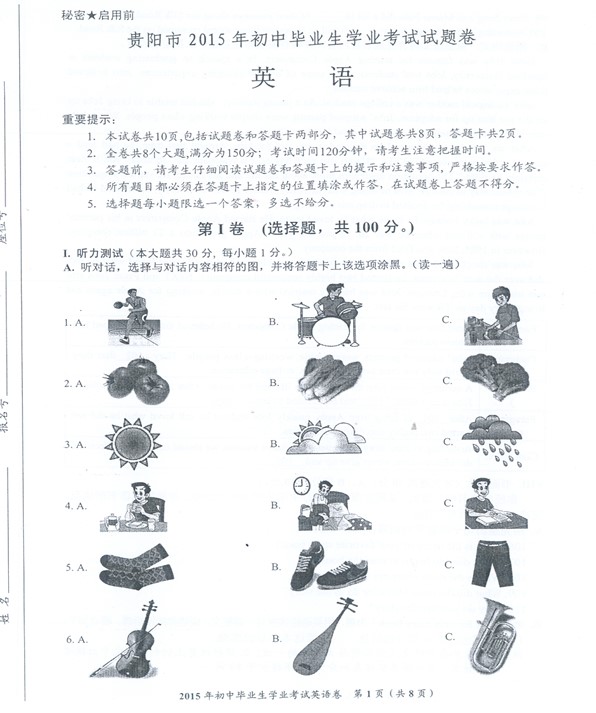
A.
21. Which of the following exhibitions lasts the longest time?
A. Buddhist paintings B. Royal collection
C. Qi Baishi‘s oeuvre D. Retrospective for an Impressionist
22. If you belive in Buddhism, where you can go to appreciate an exhibition?
A. Soka Art Center B. Art Museum of Beijing Fine Art Academy
C. Capital Museum D. Exhibition hall 17, China Art Museum Shanghai
23. From the text, we can know that if you work in Beijing and are free on Monday after 5pm, you can only enjoy ________.
A. Qi Baishi's oeuvre B. Buddhist paintings
C. Royal collection D. Retrospective for an Impressionist
B.
Restaurant chefs, home cooks, and foodies—people who love good food—often say that we eat with all of our senses.
First, we use our sense of sight to appreciate how a meal is presented, either on a dinner plate or a dining table. Our sense of touch can also be important when preparing or sharing food. Next, with our sense of smell, we breathe in the mouth-watering aromas rising up from the meal. Finally, we enjoy and perhaps even savor the food with our sense of taste.
But what about our sense of hearing? Does sound also affect our dining experience? A new report answers, ‗yes,‘ it does.
Hearing is often called ―the forgotten food sense,‖ says Ryan Elder. Elder is an assistant professor of marketing at Brigham Young University‘s Marriott School of Management. He says that if people notice the sound the food makes as they eat it, they might eat less. On the other hand, watching loud television or listening to loud music while eating can hide such noises. And this could lead to overeating.
For the study, the researchers wanted to test whether the sounds of eating–chewing, chomping and crunching—had any effect on how much a person ate. During the experiments, the test subjects wore headphones and listened to noise at either a high or low audio level. Then researchers gave them a crunchy snack: pretzels. The study found that subjects who listened to the higher volume noise ate more pretzels than those with the low audio levels.
Elder says that when hiding the sounds of eating, like when you watch television or listen to loud music while eating, we take away the sense of hearing. And this may cause you to eat more than you would normally. The researchers are calling this, the ―‖.
The researchers admit that the effects may not seem like much at one meal. But over a week, a month, or a year, all that food can really add up. But besides not overeating, there is another upside. Hearing the noises of your meal as you eat, could help you to be more mindful of the experience and perhaps help you to enjoy it more.
(文章出处:VOA April5, 2016)
24. According to the text, which of the following statements is TRUE?
A. The ―crunch effect‖ can work instantly.
B. Hearing the noises of your meal may upset your appetite for meals.
C. Our sense of hearing has little impact on the amount of food we eat.
D. We‘d better not watch loud television or listen to loud music while eating.
25. According to the text, the crunch effect refers to ________.
A. Having less than you normally would B. Eating more than you would normally
C. Enjoying the smell of the food you eat D. Appreciating whatever you eat
26. The main purpose of the passage is to ________.
A. compare and evaluate B. examine and explain C. inform and explain D. argue and discuss
27. Which of the following can be the best title for the passage?
A. Want to Lose weight? Listen to yourself Eat. B. Our Senses and Eating habitswww.shanpow.com_2016贵阳市英语试题。
C. Hearing more, Eating Less D. Be mindful of What you Eat
C.
Nearly half of all natural world heritage sites are threatened by harmful industrial activities, such as oil and gas exploration, mining and illegal logging, according to a new report released Wednesday by the World Wide Fund for Nature (WWF).
The report, titled ―Protecting People through Nature: Natural World Heritage Sites as Drivers of Sustainable Development‖, detailed global failures to protect UNESCO World Heritage sites.
According to the study, 114 natural and mixed World Heritage sites out of 229 either have oil, gas or mining concessions overlapping them or are under threat from at least one other harmful industrial activity. For example, the Belize Barrier Reef Reserve System, the second largest coral reef system in the world, is shown to be at risk from unsustainable coastal construction, large-scale mangrove clearance, harmful agricultural run-off and the potential of dangerous oil exploration.
―World Heritage sites should receive the highest levels of protection, yet we are often unable to safeguard even this important fraction of the Earth‘s surface. We all agree that these are some of the most valuable and unique places on the planet, now we need to work together to let these sites provide for the well-being of people and nature.‖ said Marco Lambertini, Director General of WWF International.
WWF is asking the private sector to make no go commitments to refrain from activities that threaten to degrade World Heritage sites. Financing should also be withheld from projects involving harmful industrial activities in World Heritage sites or the companies conducting them. In addition, national governments should ensure that no harmful industrial activities are permitted in World Heritage sites or in areas that could negatively affect them.
28. The main method the author uses to develop paragraph 3 is ________.
A. offering analyses B. providing explanations C. giving examples D. making comparisons
29. To make the World Heritage sites provide for the well-being of people and nature, Marco Lambertini emphasizes ________.
A. Education B. cooperation C. punishment D. prevention
30. The Belize Barrier Reef Reserve System are faced with the following threats except ________.
A. extensive illegal logging B. large-scale mangrove clearance
C. unsustainable coastal construction D. harmful agricultural run-off
31. The text is probably taken out of ________.
A. science fiction B. an official document C. a business report D. a news report
D.
Once upon a time, lion, the king of woods came to God and said, ―Thank you, my Lord! You have given
【三】:贵州省贵阳市六中2015-2016学年高一上学期期中英语试卷
贵阳六中2018届高一年级期中考试
英 语
时间:11月10日上午8:00-10:00 满分:150分
第一部分 听力(共两节,满分30分)
第一节 (共5小题;每小题1.5分,满分7.5分)
听下面5段对话。每段对话后有一个小题,从试题所给的A、B、C三个选项中选出最佳选项,并标在试卷的相应位置。听完每段对话后,你都有10秒钟的时间来回答有关小题和阅读下一小题。每段对话仅读一遍。
1. What’s the main reason that the man likes his college?
A. It’s not expensive.
B. It has great teachers.
C. He likes his classmates.
2. What does the man suggest the woman do?
A. Wait on the phone.
B. Order on the Internet.
C. Drive to the pizza place.
3. How much will a stamp cost in May?
A. A penny. B. 42 cents. C. 44 cents.
4. What does the man offer to do?
A. Take a message.
B. Get Ms. Sullivan.
C. Call back in thirty minutes.
5. What will the man do on Friday?
A. Go shopping.
B. Go camping.
C. Hold a dinner party.
第二节 (共15小题;每小题1.5分,满分22.5分)
听下面5段对话或独白。每段对话或独白后有几个小题,从题中所给的A、B、C三个选项中选出最佳选项,并标在试卷的相应位置。听每段对话或独白前,你将有时间阅读各个小题,每小题5秒钟;听完后,各小题将给出5秒钟的作答时间。每段对话或独白读两遍。 听第6段材料,回答第6、7题。
6. What present does the woman first suggest?
A. A toy car. B. A doll. C. A machine gun.
7. What is the relationship between the speakers?
A. Father and daughter.
B. Mother and son.
C. Sister and brother.
听第7段材料,回答第8、9题。
8. Why does the man want to learn how to cook?
A. To save money.
B. To eat a healthier diet.
C. To cook for his mother.
9. What does the woman tell the man to do first?
A. Crack the eggs.
B. Get the cooking oil.
C. Heat up some water.
听第8段材料,回答第10至12题。
10. What does Maria say about reading?
A. She reads all the time.
B. She only reads at work.
C. She doesn’t have much time to read.
11. What is Maria’s favorite type of book?
A. Biographies.
B. History.
C. Novels.
12. What might Maria’s job be?
A. A teacher.
B. A musician.
C. An athlete.
听第9段材料,回答第13至16题。
13. Where does this conversation take place?
A. In an apartment building.
B. In a workplace.
C. In a restaurant.
14. Where will the woman’s husband open a restaurant?
A. In Dallas. B. In Houston. C. In San Antonio. 15. What type of food does the man’s wife like best?
A. Thai.
B. Middle Eastern.
C. Mexican.
16. What does the man offer the woman?
A. To show her around town.
B. To introduce her to his wife.
C. To tell her about good restaurants.
听第10段材料,回答第17至20题。
17. Where is Idina Menzel from?
A. Los Angeles. B. New York. C. Chicago.
18. What is Menzel best known for right now? A. A Broadway musical.
B. Her dancing abilities.